
It’s been called Cold Australia, due to similarities in size and population density. Along with the fact it’s a former part of the British Empire, and still a Commonwealth country. The place that Donald Trump has been seriously, or not so seriously, threatening in recent times.
Canada.
Like Australia, it’s also been home to what’s considered (by some) to be a very overinflated housing market, until recently. More on that later, but this week, unlike Australia, Canada didn’t have an interest rate increase. The Bank of Canada held rates at 2.25%. Not particularly notable, but what was notable was the BoC press conference after the rate decision.
Senior Deputy Governor Carolyn Rogers said something that pricked a few ears up.
“We need house prices to fall so that housing is more affordable.”
Normally, central bankers don’t say much about the housing issue and when it comes to politicians, that’s a definite area for taking the opposite position. Back in 2024 Australian Housing Minister Clare O’Neil said the government wanted “sustainable price growth” when being quizzed by a youth radio station on housing affordability. O’Neil’s Canadian equivalent, Gregor Robertson flat out said “no” when he was questioned whether housing in Canada should be cheaper.
Robertson then went on to say it’s supply that’s the issue, something that all politicians love to talk about. Of course, there’s another side to what determines prices: demand. That’s one area politicians will rarely touch. Instead, Robertson’s supply solution was whacking up a bunch of prefab houses on federal owned land. Robertson’s prefabs have become irrelevant now because Canadian housing was becoming cheaper before he arrived in the job last year, and it continues to become cheaper.
As noted earlier, Canadian interest rates aren’t exactly at a level that would put a handbrake on house prices, so what’s behind it?
Initially, it did begin when interest rates normalised post covid in 2022. From February 2022 the Canadian overnight rate moved from 0.25% to 5% in July 2023. It held there until May 2024, when the BoC started cutting, with the last cut coming in October 2025, leaving it at 2.25%.
Canada’s Finance Minister Francois-Philippe Champagne laid it out during a visit to Australia earlier this month, telling The AFR Business Summit it was simply the demand issue.
“There’s a fundamental principle that if you accept people in the country, they need to be able to find a place to live, they need to be able to send their kids to school, and they need to be able to go to hospital if they need medical services”.
“We had reached a point of imbalances. We needed to bring that back to a sustainable level”.
Essentially less demand. Fewer People. First target? Non-permanent residents and international students, where the numbers had blown out. As can be seen by the following chart the percentage of non-permanent residents as a total of the Canadian population took off from around 2016, and exploded post covid. Justin Trudeau was elected Canadian Prime Minister in 2015.
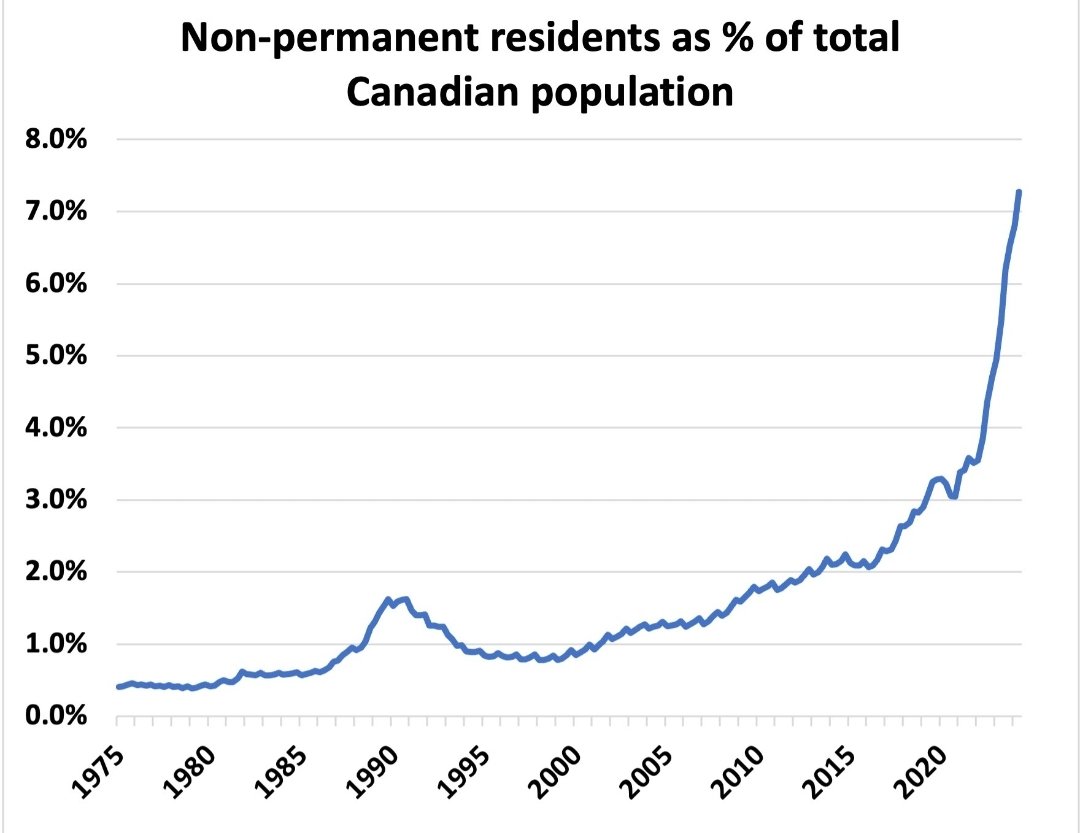
In Canada the goal is to get that figure back below 5%. In Australia it’s at 9%.
The overwhelming number of people arriving in Canada got so bad that Canadians, who were normally quite accepting of immigration overall, began to say enough. 27% of Canadians said immigration was too high in 2022, by 2024 that had spiked to 58%. An astonishing jump in two years. It also sealed Trudeau’s fate; he was replaced with Mark Carney who called an election relatively quickly and won. The party that made the mess was re-elected to clean it up, possibly because of Donald Trump’s anti-Canadian bluster.
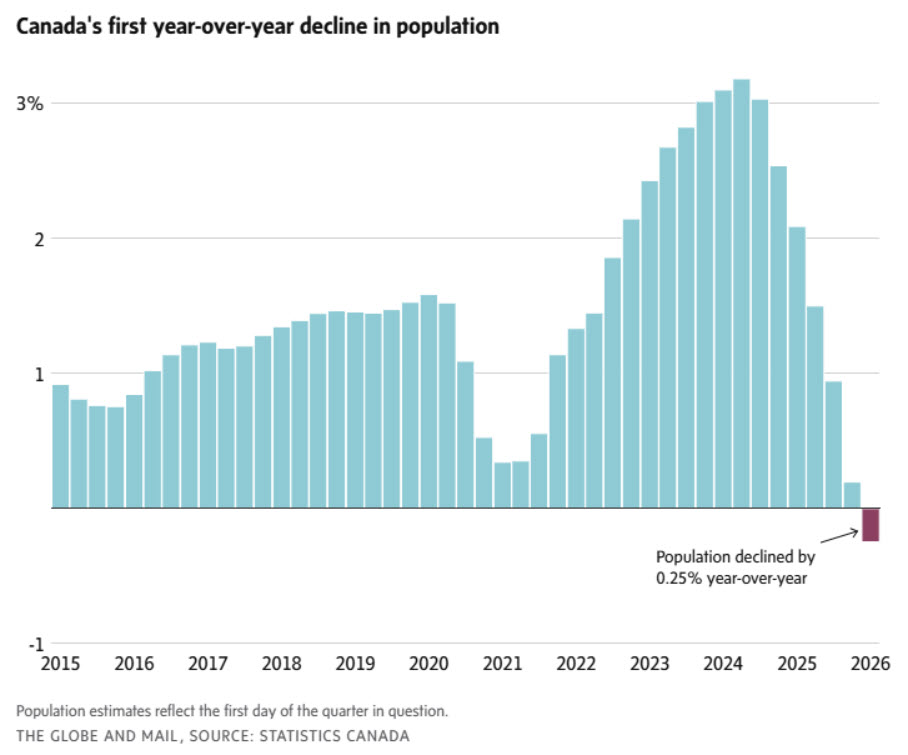
Even as interest rates dropped, there was no recovery in house prices because the previously high demand dropped off. According to StatsCan, Canada recently recorded its first annual decline in population dating back to the 1940’s.
What has this meant for house prices?
TRREB data show average GTA (Toronto) home prices fell from $1,334,544 in February 2022 to $1,008,968 in February 2026, a 24.4% decline over four years. Nationally, that’s consistent, with prices down around 20%, and going back to where they were before the covid price surge.
Rents, which spiked with the increase of people arriving in Canada, are now plummeting back down as the population numbers ease. Rentals.ca showed that the average asking rent in Canada has fallen for 17 consecutive months and sits at a 33-month low.
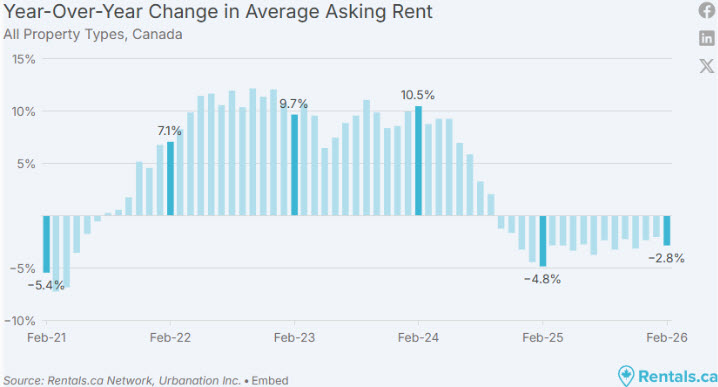
Housing affordability is improving in Canada for homebuyers and renters.
Given we’re Australian, it’s not hard to notice there have been similar concerns brewing about immigration back here. At the same time, house prices are regarded as very high, and as far as renting, capital city vacancy rates are hitting record lows. Finally, for the year to January 2026, net 494,540 people arrived in Australia on a permanent or long-term basis. This is the second-highest figure on record.
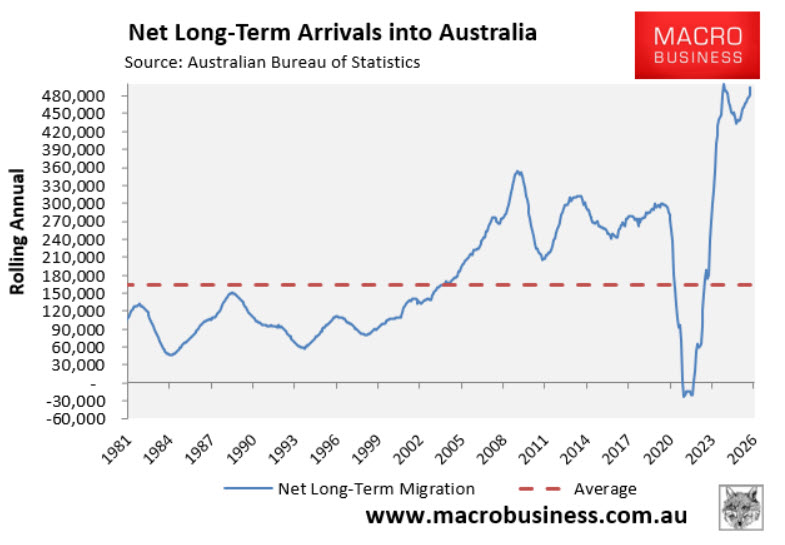
Will there be any decisions taken on immigration like the ones in Canada? Remembering Francois-Philippe Champagne’s point that “There’s a fundamental principle that if you accept people in the country, they need to be able to find a place to live”.
From Bloomberg: “Australian Prime Minister Anthony Albanese dismissed the idea of immigration cuts or tighter border checks, even as electoral polls show a surge in support for the country’s hard-right One Nation Party.”
Australia’s inflation figures have been going in an unfavourable direction, and according to polls, One Nation has replaced the LNP as the opposition nationally, its major bugbear is immigration, which is why they also have a net zero immigration policy. One Nation’s polling numbers continue to increase by the week.
Despite the multi-year house price falls in Canada, Mark Carney enjoys very high polling numbers. People will continue to ask the question. Will the Labor Government look to Canada and address the population issue, or will One Nation continue to grow as population and immigration is considered off limits?
If Canada is any guide, the population direction and the reality of demand will heavily dictate house prices and rents in the future.
This represents general information only. Before making any financial or investment decisions, we recommend you consult a financial planner to take into account your personal investment objectives, financial situation and individual needs.